Can Magnetic Fields Power the Green Transition? iNANO Joins Bold ERC Project
Can magnetism spark a green energy breakthrough? A new ERC Synergy project, iNANO’s Jeppe Vang Lauritsen and partners will explore how magnetic fields can supercharge clean fuel and chemical production—making tomorrow’s energy smarter and more sustainable. Their findings may help drive new climate technologies and replace fossil-based processes with cleaner solutions powered by electricity and innovation.

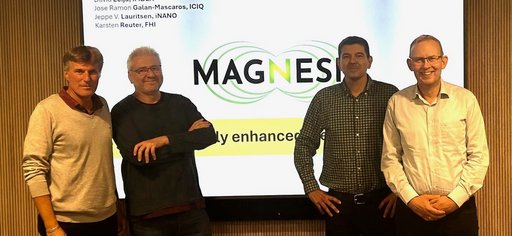
The awarded project, entitled ‘Magnetically enhanced electrocatalysis’ - MAGNESIS, will join the efforts of Prof. Galán-Mascarós (ICIQ), Prof. Karsten Reuter (Fritz Haber Institute of the Max Planck Society, Germany), Prof. Jeppe V. Lauritsen (Aarhus University, Denmark) and Prof. David Écija (IMDEA Nanociencia, Spain). With a total budget of €12 million and a duration of six years, the project aims to understand the fundamental principles behind the synergy between magnetic fields and electrocatalytic performance, from atomic-scale model systems to full-cell devices.
In recent years, electrochemistry and electrocatalysis have become central to the transition toward sustainable industrial processes, offering the potential to replace fossil-fuel-based methods with cleaner, electricity-driven alternatives. However, these technologies still face significant performance challenges. The recent discovery that magnetic fields can enhance electrocatalytic reactions has opened a new research frontier.
“This project gives us an opportunity to define the first theoretical and experimental framework for controlling electrochemical reactions with magnetic fields, a breakthrough that could transform the way sustainable fuels and chemicals are produced in the future” says Prof. Galán-Mascarós, ICREA Research Professor and Senior Group Leader at ICIQ, coordinator of the project.
MAGNESIS aims to provide a scientific foundation for this promising approach by combining expertise in catalysis, surface science, magnetism, and theory. The project will focus on two key reactions: water oxidation and carbon dioxide reduction, both of which may be sensitive to spin effects. Through the use of advanced experimental and computational tools, the team will identify the structural, electronic, and magnetic descriptors that govern these processes, thereby establishing the fundamental principles of magneto-electrochemical science and technology.
“The power of surface science will allow us to probe the mechanisms of magnetoelectrocatalysis at the ultimate spatial scale,” states Prof. David Écija from IMDEA Nanociencia.
The overarching goal of the project is to validate this new phenomenon through the development of more efficient electrochemical devices that can have an impact in the energy transition, through the production of renewable fuels and chemicals.
“We aim to uncover how magnetic fields shape the chemical reactions that drive clean energy, by extending our computer models to include magnetism, we hope to unlock new ways to make electrocatalysis more efficient, enabling renewable-energy-driven chemical production, advancing materials research, and controlling reactions at the molecular level,” declares Prof. Karsten Reuter from Fritz Haber Institute of the Max Planck Society.
As its name suggests, ERC Synergy Grants are built on the principle of collaboration, supporting ambitious initiatives that can only be achieved through the combined efforts of several leading research teams to push the boundaries of scientific discovery.
“The ERC synergy is a perfect match for the topic since it requires collaboration among many types of expertise, and it will be very exciting to be working with world-leading expects in surface science, computational modeling, magnetism and electrocatalysis" concludes Prof. Jeppe V. Lauritsen from Aarhus University.
Contact
Professor Jeppe Vang Lauritsen
Interdisciplinary Nanoscience Centre (iNANO)
Aarhus University